
Your first field notes
PokéSurvivor Beginner Guide
Choose a starter, keep moving, collect experience and improve the move you are actually using. PokéSurvivor attacks automatically with the selected active move, so survival depends on positioning and switching attacks when the enemy or weather changes. Sign in before building a collection, then choose a starter and prepare for the first boss at three minutes. The online edition saves account progress in the cloud; the downloadable solo edition keeps progress in that browser's local storage.
Movement and move selection
- WASD / arrow keys
- Move on a keyboard. Keep enough room to turn away from a closing horde.
- 1–4
- Select one of your four move slots. The selected attack fires automatically.
- Q / E or a move icon
- Cycle slots or select a move directly. Switch when your current attack is resisted.
- Esc
- Pause from the keyboard.
- Touch in landscape
- Drag anywhere to move; tap a move to select it. Use the top-right pause button.
From the title screen to the first boss
Choose how to save: Guest mode starts immediately, but guest progress is not saved. Use the official game's name-and-password account or Google sign-in when you want cloud progress across devices. For downloaded solo play, the author's itch.io edition saves in the local browser and does not provide online co-op, cloud saves or leaderboards.
Select one of the 29 starters: Take the personality test if you want a suggestion. You can reject its result and choose another starting partner. Check the partner's starting move and types before committing: a dual-type partner gets access to both of its typed move pools, in addition to Normal moves. The starter filter in the Pokédex separates these opening choices from partners that require collection first.
Build a safe movement loop: Move in wide circles so enemies follow behind you instead of surrounding you. Step out of filling circles and lines on the ground; they signal an incoming attack. Healers and shield-casters can sustain the group chasing you, so target those enemies when a safe opening appears. Moving into a telegraphed strike to collect experience trades away the space you need to escape.
Collect experience and choose a card: Gather experience to level up, then choose from three offered cards. The choices can add a new move, improve an existing move or raise a run stat. A new slot gives you another attack to select, rather than four attacks firing at once. When your current move fits the enemies ahead, upgrading it improves the attack you are already relying on.
Prepare before the three-minute boss: The first ordinary boss slot is at 3:00. Before that point, check which attack is active and leave room to dodge marked attacks. Select coverage that suits the boss's types instead of assuming your starting move will always be effective. Continue circling when the horde closes in; a boss fight still requires movement around the other enemies on the map.
Build a move pool you can actually use
Each partner can learn Normal moves and moves matching its own types. Bulbasaur, for example, starts with Vine Whip and can take Grass, Poison and Normal choices. Charmander starts with Ember and can take Fire and Normal moves. The starting move therefore matters immediately, while the learnset determines your later coverage options.
Move behavior matters alongside damage. Vine Whip sweeps a wide melee arc; Ember launches a fireball at the nearest enemy; Water Gun sends out a piercing jet. Choose spacing that suits the active attack. Swords Dance is a buff with no direct damage, so selecting it changes what your active slot is doing. Bonded moves are the exception to separate-slot attacks: a bonded group fires together, occupies one slot and can contain up to four moves.
Complete all three move-evolution requirements
Raise the base move to its maximum level, take its required stat card during the current run, then select the golden evolution card when it is offered. Reaching level 5 alone does not finish the evolution. Permanent partner upgrades are a separate system and do not replace the requirement to take the matching run card.
Base move damage and cooldown exclude partner bonuses, weather and type effectiveness. Use them to identify the opening attack and its destination, rather than treating damage divided by cooldown as guaranteed combat DPS. PokéSurvivor has 64 base moves, of which 59 can evolve. Buff moves have no evolution mapping; do not wait for a golden evolution of Swords Dance.
| Base move | Behavior | Base damage | Cooldown | Evolution | Required run card |
|---|---|---|---|---|---|
| Tackle | Melee arc | 16 | 0.5s | Take Down | Vigor (HP) |
| Vine Whip | Melee arc | 19 | 0.62s | Power Whip | Power (Attack) |
| Ember | Projectile | 18 | 0.52s | Fire Blast | Power (Attack) |
| Water Gun | Projectile | 14 | 0.44s | Scald | Power (Attack) |
Switch for the game's type chart and weather
PokéSurvivor softens the familiar Pokémon matchups: super-effective attacks deal ×1.6, resisted attacks ×0.6 and attacks corresponding to main-series immunities ×0.3. For a dual-type target, multiply the two matchups and clamp the type result between ×0.3 and ×2.4. An attack that is strong against both types reaches ×2.4 after the cap, rather than the uncapped ×2.56.
Weather can change which of your available moves works best. At full intensity, rain boosts Water to ×1.5 and Electric to ×1.2 while reducing Fire to ×0.5; sun boosts Fire to ×1.5 and reduces Water to ×0.5. Snow boosts Ice and slows non-Ice partners by 10%. These weather effects are separate from the type-chart result. Recheck your active slot when weather changes, especially if your partner carries both a favored and a weakened attack.
Pick one held item and upgrade the partner you use
You can equip one held item during a run. Finding another item gives you a replacement decision. Leftovers restores 1.5% of your HP per second, while Quick Claw reduces move cooldowns by 20%. Choice Band adds 40% damage but prevents move switching, which changes the matchup strategy above. Life Orb adds 30% damage at an HP cost on each attack; its tradeoff matters when you are already taking hits.
After the run, spend PokéCoins on the partner you intend to play again. Permanent upgrades apply to that specific Pokémon, rather than to the entire collection. Unlocking a different partner therefore does not transfer those upgrades. Check the next-level price and the track's cap before splitting your coins across several partners.
Treat bosses, rifts and Judgment as different encounters
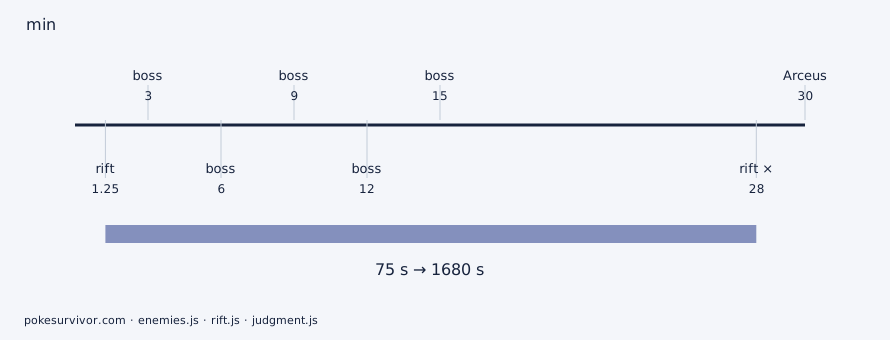
Ordinary boss slots occur at 3, 6, 9, 12 and 15 minutes. Rift checks begin after 75 run seconds and repeat every 30 seconds when eligible; a living regular boss prevents a check from counting. A portal is available for 45 seconds, and entering starts a legendary arena with a 120-second combat limit. Check your move coverage before entering instead of treating the portal as a guaranteed reward.
Winning an ordinary rift grants a Bond. It does not directly add that normal legendary partner to your collection; regional gacha is the separate collection route. Ordinary rifts stop opening at minute 28. At minute 30, Arceus begins Judgment, where Arceus is invincible and your objective is survival. A plan built only around defeating the five ordinary bosses does not describe that final encounter.
Expand your choices between runs
Use tickets earned by playing in the regional gacha banner containing your target. One pull costs one regular ticket; ten pulls cost ten regular tickets or one ten-pull ticket. Each banner tracks its own five-star pity. A five-star result is a rarity outcome, not proof that the partner has the legendary flag. Check your target's region, rarity and legendary status before using tickets.
Wild shiny acquisition is different: an eligible wild enemy has a 1-in-4096 shiny roll, and defeating a shiny unlocks its shiny partner form. A supported gacha result has a 1% shiny roll. Those probabilities describe eligible trials, not a promise that a particular species will appear within a fixed number of enemies or pulls. First confirm that the partner supports a shiny form.
Start co-op with an online account
On the official online site, add friends by nickname, create a room and send invitations. Rooms support up to four players. Experience and team leveling are coordinated by the host, so a group run changes the progression setup from solo play. To revive a fallen teammate, stay nearby for three seconds; the revived player returns with half of their maximum HP.
More players also change the horde: with four players, ordinary enemy HP is ×1.9 and spawn rate is ×3.25 compared with solo, using the game's player-count formulas. Choose partners and coverage together, and leave a safe space for revives. Use the online browser edition for these features; the author's downloadable edition is for offline solo play.
Sources
- Official guide: controls, accounts and survival advice
- Official move data and evolution requirements
- Official level-up choices
- Official softened type chart
- Official weather effects
- Official held-item effects
- Official partner upgrade application
- Official regional collection rules
- Official co-op scaling and host progression
- Official rift rules and Bond rewards
- Official Judgment encounter
- Official solo download and edition differences