
Field conditions · Five weather states
PokéSurvivor Weather
Weather changes attack damage according to the move's type. Harsh sunlight, rain, sandstorm, snowfall and fog each favor different attacks, while sand and snow also threaten partners without a protective type. A weather boost does not replace the enemy's type matchup: both factors matter. Use the comparison below to choose an active move, then check whether your partner needs to protect its remaining HP or leave more space for movement. The listed damage factors apply at full weather intensity.
The Judgment of Arceus update · 13 October 2026.
All five weather states
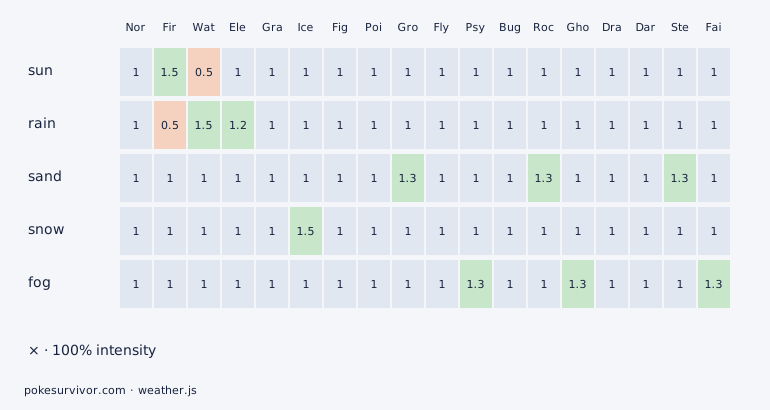
Each listed damage factor follows the attack's type, even when the partner has different types. Attack types absent from a row stay at ×1 for that weather. Protection from chip damage and slowdown follows the partner's own types instead; carrying an Ice move does not make a non-Ice partner snow-safe.
| Weather | Attack damage | Partner chip damage | Movement speed |
|---|---|---|---|
| Harsh sunlight | None | Unchanged | |
| Rain | None | Unchanged | |
| Sandstorm | Periodic HP loss unless the partner has Rock, Ground or Steel | Unchanged | |
| Snowfall |
| Periodic HP loss unless the partner has Ice | Non-Ice partners ×0.9; Ice partners unchanged |
| Fog | None | Unchanged |
How to respond when the weather changes
Harsh sunlight
Harsh sunlight raises Fire attack damage by 50% and halves Water attack damage. If both are available, compare their matchups against the enemy before switching: the weather advantage is only one part of the calculation. Sun adds neither environmental chip damage nor a movement penalty. A Water partner can still use another learned attack without changing its own types; check its learnset rather than assuming every move shares the partner's type.
Rain
Rain raises Water attack damage by 50%, raises Electric damage by 20% and halves Fire damage. The Electric bonus is smaller than the Water bonus, so they are not interchangeable weather buffs. A favorable enemy matchup can still make the smaller bonus useful. Rain does not introduce the snow movement penalty or the sandstorm chip tick. If your normal Fire attack becomes weak, compare an available Water, Electric or unaffected attack instead of waiting for the entire weather event to end.
Sandstorm
Sandstorm boosts Rock, Ground and Steel attacks by 30%. Those same three types protect a partner from its chip damage, and a dual-type partner needs only one of them for protection. These are separate checks: a Rock attack gets the damage boost even when its user remains vulnerable to the storm. Sandstorm does not slow movement. With an unprotected partner, watch HP while collecting pickups; taking environmental damage can reduce the room you have to survive the next enemy hit.
Snowfall
Snowfall boosts Ice attacks by 50%. An Ice partner avoids both the chip damage and the movement penalty; other partners move at 90% of their usual speed at full intensity. At an otherwise unchanged speed of 100, the weather contribution gives 90. Leave a wider escape path before moving into a group of enemies, because your usual gap may close more quickly. Learning an Ice attack improves offense in snow but does not remove either penalty from a non-Ice partner.
Fog
Fog raises Ghost, Fairy and Psychic attack damage by 30%. It causes neither environmental chip damage nor movement slowdown. Compare an available attack of one of those types with the enemy's resistances before changing slots. Fog changes the screen's appearance and boosts those three attack types; it does not reduce accuracy or weaken unrelated attack types.
Combine weather with the real type matchup
PokéSurvivor softens super-effective, resisted and main-series immunity matchups to ×1.6, ×0.6 and ×0.3. Against a dual-type enemy, multiply the two contributions, clamp that product to ×0.3–×2.4, then apply weather. The weather result can therefore exceed ×2.4; that cap applies to the type product before the weather factor.
| Condition | Type product | Clamped type factor | Weather factor | Combined factor |
|---|---|---|---|---|
| No weather | ×2.56 | ×2.4 | ×1 | ×2.4 |
| Harsh sunlight | ×2.56 | ×2.4 | ×1.5 | ×3.6 |
| Rain | ×2.56 | ×2.4 | ×0.5 | ×1.2 |
These factors compare type and weather only. They do not include the move's base damage, attack upgrades, critical hits or other combat modifiers. Change the types and weather intensity in the Type Calculator for a different encounter.
When ordinary weather can begin
Ordinary weather becomes eligible after 120 run seconds. The weather system then counts down a 60-second check timer and rolls an 18% chance when that timer expires. On an uninterrupted normal run, the first roll is around minute three; minute two is the eligibility threshold, not a guaranteed weather announcement. Failed rolls lead to another check rather than ensuring an event at a fixed minute.
A normal event lasts a randomly chosen 55–75 seconds. The next check timer counts down while no weather is active, and normal random starts are blocked inside a rift arena or during the Judgment. Weather choice is weighted by the current biome: forest favors rain, cave favors fog and snow, and volcano favors sun and sandstorm. The five states are not equally likely in every location.
Why the effect changes during the first and last seconds
Weather fades in and out over three seconds. Its intensity runs from zero to one, and an affected attack uses 1 + (full-intensity multiplier − 1) × intensity. At half intensity, rain gives Water ×1.25, Electric ×1.1 and Fire ×0.75. At full intensity those become ×1.5, ×1.2 and ×0.5. An attack type without a modifier remains at ×1 throughout the transition.
The snow speed contribution also follows intensity: a non-Ice partner receives 1 − 0.1 × intensity. Half-intensity snow therefore gives ×0.95 movement speed, reaching ×0.9 at full strength. Judge an escape route using the active condition, especially as snow finishes fading in.
Sandstorm and snow chip damage
The weather system checks chip damage every two seconds, with damage active only above half intensity. For an unprotected living player, each eligible tick removes the greater of 1 HP or 1.2% of maximum HP. At 200 maximum HP, that is 2.4 HP per tick. The game applies it only when current HP is greater than the tick amount plus 1, so weather chip itself cannot knock you out. Enemy attacks can still finish a player whose HP has been lowered by weather.
Protection requires any one safe partner type: Rock, Ground or Steel for sandstorm, and Ice for snow. Regular vulnerable enemies also take chip damage, using 2% of their maximum HP plus 1 per eligible tick. Bosses are exempt from environmental chip damage; in co-op, the host applies it to living ordinary enemies. Unlike the protected player floor, those ordinary enemies can die from the weather tick. A storm can help clear enemies while still reducing your own safety margin.
Rift weather and co-op authority
A rift arena can force its own themed weather instead of using the ordinary random roll. Fire arenas use sun; Water and Electric arenas use rain; Ice arenas use snow; Ground and Rock arenas use sandstorm; Ghost arenas use fog. Other type arenas have no configured weather, including Steel and Fairy even though their attacks can benefit from sand or fog elsewhere. The forced weather is initialized for 135 seconds and is cleared when you leave, so the normal 55–75-second event duration is not a reliable arena countdown.
The Judgment clears existing weather when its encounter begins, and normal weather does not start while it is active. In co-op, the host decides ordinary weather and broadcasts the event to the room. Partners can experience the same storm differently because protection and slowdown depend on each partner's own types. Before entering a themed arena together, compare both the chosen attacks and each player's weather protection.
Sources
- Official weather system: multipliers, protection, timing, intensity and chip damage
- Official English weather names
- Official softened type chart and dual-type clamp
- Official combat calculation: type factor multiplied by weather
- Official arena themes and their configured weather
- Official rift system: forced weather duration and clearing on exit
- Official Judgment encounter clears weather