
Type arenas · legendary encounters · Judgment
PokéSurvivor Rift Arenas
A PokéSurvivor rift is a temporary portal to a closed arena with a legendary opponent. You have 45 seconds to enter an open portal and 120 seconds to win the arena fight. A normal victory awards a Bond for move fusion; it does not directly give you the normal legendary as a playable partner. The minute-30 Judgment of Arceus is a separate survival encounter with different enemies, rewards and objectives.
A portal-to-return checklist
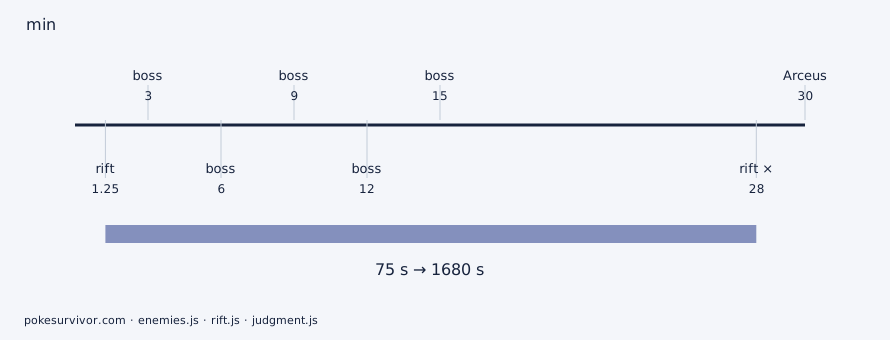
Check the run clock and regular boss: Ordinary rift checks become eligible after 75 run seconds and stop at minute 28. A living regular boss blocks a check from counting, so finish that encounter before expecting another portal opportunity.
Approach before the portal expires: An open portal lasts 45 seconds. In co-op, entering it takes the entire group to the arena. Tell your teammates before touching it; they do not each need to find a separate entrance.
Identify the opponent, arena and weather: The arena uses one of the legendary's types. Check the opponent's full type pair when choosing an attack, and account for the arena's forced weather rather than relying on its name alone.
Win within the arena limit: Defeat the legendary before the 120-second limit. Keep a movement route around obstacles and allow time to rescue teammates. A timeout or the whole group going down ends the attempt without the victory reward.
Return and use the Bond: After a victory, the game returns you to the field and offers an eligible move fusion. Check your position when the map enemies return. After a failed attempt, you still return to continue the run.
When rifts can open
The opening system uses a 30-second check countdown once the run is past 75 seconds. Consecutive eligible misses increase the next opening-roll chance by 20 percentage points. A successful opening roll resets that sequence. Each eligible check can open one portal; the rising chance does not set five fixed portal times.
A living regular boss blocks the next rift check without advancing its chance. An existing portal or an active arena also interrupts the normal check sequence, and new openings stop at minute 28. Even a 100% opening roll still needs the game to find a free location for the portal. Avoid interpreting the increasing chances as a guarantee that a portal will be visible every two and a half minutes regardless of the field state.
| Eligible check | Opening-roll chance |
|---|---|
| 1 | 20% |
| 2 | 40% |
| 3 | 60% |
| 4 | 80% |
| 5 | 100% |
| Run time | What happens | What to do |
|---|---|---|
| After 1:15 | The 30-second rift-check countdown becomes active | Keep moving; a portal is not guaranteed to appear at 1:15. |
| 3:00 · 6:00 · 9:00 · 12:00 · 15:00 | The five ordinary boss slots | Clear a living boss so eligible rift checks can count again. |
| 28:00 onward | No new ordinary rifts open | Use the remaining field time to prepare for Judgment. |
| 30:00 | Judgment becomes due | Prepare to survive Arceus; an active rift or card choice finishes before the transition. |
The 18 type arenas and their weather
The legendary is selected first, then one of its types determines the arena. A dual-type opponent can therefore appear in different arena themes. The theme does not replace the opponent's defensive types: Articuno remains Ice/Flying in both Eternal Glacier and Sky Peak.
Arena weather can change the value of an otherwise useful attack. At full intensity, sun boosts Fire ×1.5 and halves Water; rain boosts Water ×1.5 and Electric ×1.2 while halving Fire. Snow boosts Ice ×1.5 and slows non-Ice partners by 10%. Sandstorm boosts Rock, Ground and Steel attacks ×1.3; those partner types also avoid its chip damage. Fog boosts Ghost, Fairy and Psychic attacks ×1.3.
| Arena type | Arena | Forced weather |
|---|---|---|
| Normal | Eternal Meadow | No forced weather |
| Fire | Igneous Volcano | Sun |
| Water | Sea Grotto | Rain |
| Electric | Volt Plant | Rain |
| Grass | Emerald Jungle | No forced weather |
| Ice | Eternal Glacier | Snow |
| Fighting | Ancient Dojo | No forced weather |
| Poison | Toxic Swamp | No forced weather |
| Ground | Red Desert | Sandstorm |
| Flying | Sky Peak | No forced weather |
| Psychic | Mind Temple | No forced weather |
| Bug | Hive Forest | No forced weather |
| Rock | Ancient Quarry | Sandstorm |
| Ghost | Gloomy Graveyard | Fog |
| Dragon | Dragon Sanctuary | No forced weather |
| Dark | Dark Alley | No forced weather |
| Steel | Steel Fortress | No forced weather |
| Fairy | Enchanted Forest | No forced weather |
Use the full type pair when choosing attacks
PokéSurvivor changes main-series matchups to ×1.6 for a weakness, ×0.6 for a resistance and ×0.3 for an immunity. Multiply both contributions against a dual-type opponent, then clamp the type result to ×0.3–×2.4. Two weaknesses produce ×2.4 after the cap rather than the raw ×2.56.
Articuno shows why the second type matters. Rock is strong against both Ice and Flying, reaching the cap. Fighting is strong against Ice but resisted by Flying, so its combined type factor is ×0.96. Ground against Fire/Flying Moltres combines ×1.6 and ×0.3 for ×0.48. Electric against Ground Groudon still deals ×0.3 type damage, rather than zero. These examples exclude weather, move strength and partner upgrades.
Look up the legendary before planning a specific hunt, then check which attacks your partner can actually learn. Switch to an appropriate learned move during the fight. An arena's Fire or Ice label alone is not enough to decide your best attack against a dual-type boss.
Fight, timeout and the return to the field
During an ordinary arena, field enemies are stored and normal spawning pauses. The fight takes place inside a bounded arena, and the legendary collides with its walls and columns. Keep a clear line for your attacks while moving around the obstacles; letting a column sit between you and the opponent can waste part of the combat window.
The opponent's HP grows with run time: round((3200 + run seconds × 9) × player-count HP factor × multiplayer arena factor). The player-count factor is 1 + 0.3 × (N − 1), and the arena factor is ×1.4 for a group of two or more. For four players, the combined factor is ×2.66 compared with solo at the same run time. This HP formula does not predict your clear time.
A victory gives a short reward interval before returning. A failed arena sends you back without its victory reward; a fallen local player is revived at 30% maximum HP on return. The stored field enemies resume afterward, so the transfer does not erase the horde you left behind. In co-op, allow teammates time to regain their position before continuing.
Bonds, collection unlocks and repeat opponents
Each ordinary rift victory grants a Bond. A Bond combines learned moves into one active group: begin with two separate moves, then add eligible loose moves to the existing group up to four. You need suitable learned moves for a fusion option; owning a Bond alone does not supply a new attack or a new Pokémon. In co-op, fusion choices pause the group until the players finish.
Defeating an ordinary, non-shiny legendary does not directly add its normal partner to your collection. Use the appropriate regional gacha for that acquisition route. A shiny-capable legendary has a 1-in-512 shiny roll when the rift opponent is selected, and defeating a shiny enemy unlocks its shiny partner form. Entering an arena or seeing a shiny is not the defeat required for that unlock.
An opponent you have not yet defeated has selection weight 4; one already defeated has weight 1. This favors new encounters but does not prevent repeats or guarantee a specific missing legendary next. Rift arena victories and unique legendary defeats are also different achievement targets: winning the same type arena again cannot fill a missing arena type.
At minute 30, survive the Judgment of Arceus
Judgment begins when the run reaches 30 minutes. If you are still in a rift or choosing a level-up card, the transition waits until that activity finishes. Arceus is invincible and is not an attack target. Prioritize movement and the ground warnings while attacking the damageable legendary summons when you have an opening.
Legendary summons arrive every five seconds. Each successive summon has twice the HP and damage of the preceding one, so pressure increases even if your build handled the first opponent. They give XP but no coins, tickets or items. Judgment has no fixed survival time limit and no ordinary-rift victory condition; the aim is to extend the attempt.
Arceus pursues players faster as the fight continues. His contact and warned attacks use maximum-HP percentages and ignore type and defense. Read the hazards below as movement priorities. Reaching Judgment, lasting another 60 seconds and defeating three summons in one Judgment are separate achievement goals; summon defeats do not substitute for ordinary rift legendary records.
| Rule | Ordinary rift | Judgment |
|---|---|---|
| Entry | Enter a temporary field portal | Triggered by reaching minute 30 |
| Main target | A damageable legendary opponent | Invincible Arceus plus damageable legendary summons |
| Objective | Defeat the opponent within 120 seconds | Survive as long as possible; no fixed arena time limit |
| Encounter rewards | Bond for a win, plus the defeated opponent's drops | Summons give XP, with no coin, ticket or item drops |
| Progress | Rift and defeated-legendary records | Separate Judgment survival and summon-defeat records |
Light pillars: Watch the ground warnings around living players and leave the marked areas. The pillars deal 30% maximum-HP damage, and the number of pillars increases as Judgment continues.
Cross beams: Move out of the warned beam lines before they fire. Their damage is 35% of maximum HP; the pattern increases from four beams to eight after 30 seconds in the fight.
Close-range nova and contact: Avoid lingering beside Arceus. The warned nova and direct contact each deal 40% of maximum HP. These attacks ignore type and defense, so a favorable type matchup cannot make standing beside him safe.
Sources
- Official rift opening, selection, arena limits and Bond rules
- Official type arena themes and forced weather
- Official softened type factors and dual-type clamp
- Official Judgment timing, summons and Arceus attacks
- Official move fusion and player revival
- Official weather damage and movement modifiers
- Official achievement requirements