
Combat workbench · type and weather factors
PokéSurvivor Type Calculator
Choose a move’s attack type and the target’s one or two defending types to calculate its PokéSurvivor damage factor. The game softens weaknesses, resistances and immunities, so a familiar main-series matchup can produce a different result here. Combine the two defending types' factors, apply the game's floor and ceiling, then include active weather if needed. Use it to compare attacks before a boss or rift encounter, then check the move’s behavior and your partner’s learnset when choosing what to carry.
Calculate a matchup
Attack damage factor
Type factor clamped 0.3x–2.4x
- Fire → Bug: ×1.6
- Fire → Grass: ×1.6
- Type product
- ×2.56
- After type clamp
- ×2.4
- Weather factor
- ×1
×2.4 × 1 = ×2.4
Set the inputs for your next fight
Use the move’s type: Select the attack you intend to use, rather than the attacking partner’s primary type. A partner can learn moves of several types. For incoming damage, use the enemy’s primary type or the type of its projectile as the attacking input.
Enter both target types: Check the target’s partner or legendary record. A single-type target needs only the primary field. For a dual-type target, include the second type even when one half looks favorable: resistance can offset weakness, and a softened immunity still permits damage.
Apply the weather that is active: Select clear weather for the ordinary chart result. Choose an active weather state to include its damage modifier. Full intensity describes the middle of the weather period; the 50% option illustrates the three-second fade at its beginning or end.
Matchups that change the attack decision
These examples separate the type cap from weather. The two defender contributions are multiplied first; the final column then includes the chosen weather at full intensity.
| Attack | Defender types | Contributions | Type product | Clamped type | Weather | Final factor |
|---|---|---|---|---|---|---|
| Fire | Bug / Grass | ×1.6 · ×1.6 | ×2.56 | ×2.4 | Harsh sunlight | ×3.6 |
| Grass | Grass / Poison | ×0.6 · ×0.6 | ×0.36 | ×0.36 | Clear · no weather | ×0.36 |
| Electric | Ground / Grass | ×0.3 · ×0.6 | ×0.18 | ×0.3 | Clear · no weather | ×0.3 |
| Electric | Ground / Flying | ×0.3 · ×1.6 | ×0.48 | ×0.48 | Clear · no weather | ×0.48 |
| Fire | Water / Grass | ×0.6 · ×1.6 | ×0.96 | ×0.96 | Clear · no weather | ×0.96 |
Weather changes after the type calculation
Weather scales only the attack types listed below; every other attack type keeps a weather factor of ×1. At half intensity, a full-strength ×1.5 boost becomes ×1.25 and a ×0.5 penalty becomes ×0.75. The interpolation is 1 + (full-strength factor − 1) × intensity.
| Weather | Affected attack types |
|---|---|
| Harsh sunlight | Fire ×1.5 · Water ×0.5 |
| Rain | Water ×1.5 · Electric ×1.2 · Fire ×0.5 |
| Sandstorm | Rock ×1.3 · Ground ×1.3 · Steel ×1.3 |
| Snow | Ice ×1.5 |
| Fog | Ghost ×1.3 · Fairy ×1.3 · Psychic ×1.3 |
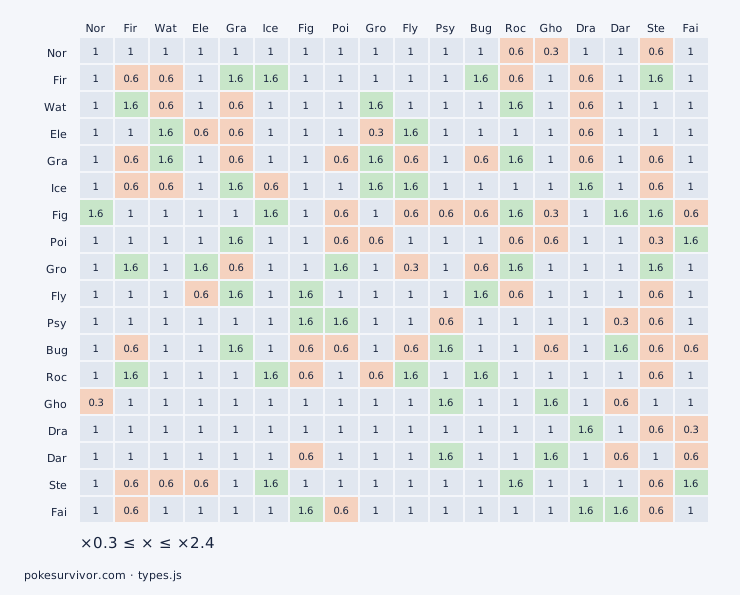
Read the intermediate values before the final factor
The type product tells you how the two defending types interact. Two ×1.6 contributions produce ×2.56, which the upper bound reduces to ×2.4. Two ×0.6 contributions produce ×0.36, which stays above the ×0.3 floor. A ×0.3 contribution multiplied by ×0.6 produces ×0.18, so the lower bound raises the type result to ×0.3. These bounds apply to the combined type factor, rather than replacing each cell.
An apparent weakness and resistance do not cancel perfectly: ×1.6 multiplied by ×0.6 gives ×0.96. Electric against Ground/Flying gives ×0.48 because Ground contributes ×0.3 and Flying contributes ×1.6. Neither case is an absolute immunity. Compare the numeric outputs when deciding whether an alternative move improves the matchup.
The weather-adjusted result can exceed ×2.4. Fire into Bug/Grass reaches the type ceiling, then harsh sunlight multiplies that ×2.4 by ×1.5 to reach ×3.6. Applying the cap a second time would hide the weather advantage. Conversely, rain halves Fire damage after the type calculation, even when its type matchup is favorable.
Compare coverage without mistaking it for DPS
This factor is one part of a hit’s damage. A move’s level, base damage, the partner’s attack multiplier and run effects also matter. Cooldown alone cannot capture a beam’s contact time, a projectile’s path, a ground zone’s repeated hits or a melee arc’s reach. A higher type factor is useful when comparing coverage, but it does not establish that one move always deals more total damage than another.
Check both sides of a rift encounter. First enter the boss’s defending types to inspect your planned attack. Then use an enemy attack as the attacker and your own partner’s types as the defender. Outgoing coverage and incoming resistance answer different questions; switching their positions can change the multiplier. Weather affects enemy attacks too, so the same active state can help your attack while increasing danger from another type.
After finding a useful attack type, check which of your selected partners can actually learn it. In the Team Planner, choose reachable moves for each partner, compare incoming weaknesses and use damaging attacks for offensive coverage. Use the move-evolution guide to prepare the required run card and golden evolution choice for the attacks you plan to develop.