
Regional collection · Kanto to Paldea · 966 partners
PokéSurvivor Regions
Choose a region by the Pokémon you want to collect. PokéSurvivor has nine regional gacha banners, from Kanto to Paldea, and each draws from its own generation's partner pool. The regions share the same base rarity rates, but the number of Pokémon within each rarity differs. Open a region to see every member, its game stats, starting move and collection options. Check five-star rarity, legendary status and shiny availability separately when choosing a collection target.
Nine regional partner collections
Every region name opens its complete roster. Compare the number of playable partners, selectable starters and available shiny forms in each region. Search for a region name to narrow the directory.
| Region | Generation | Legendary partners | Partners | Shiny variants | Starter partners |
|---|---|---|---|---|---|
| Kanto | 1 | 5 | 151 | 151 | 5 |
| Johto | 2 | 6 | 100 | 100 | 3 |
| Hoenn | 3 | 10 | 135 | 135 | 3 |
| Sinnoh | 4 | 14 | 107 | 107 | 3 |
| Unova | 5 | 13 | 141 | 140 | 3 |
| Kalos | 6 | 6 | 70 | 70 | 3 |
| Alola | 7 | 16 | 83 | 83 | 3 |
| Galar | 8 | 11 | 87 | 83 | 3 |
| Paldea | 9 | 6 | 92 | 89 | 3 |
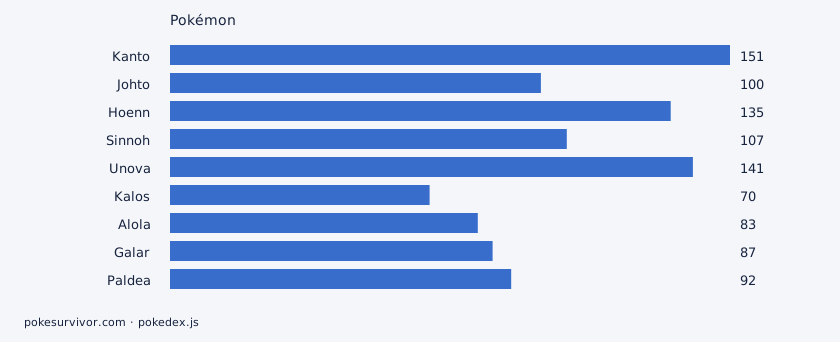
| Region | Partners |
|---|---|
| Kanto | 151 |
| Johto | 100 |
| Hoenn | 135 |
| Sinnoh | 107 |
| Unova | 141 |
| Kalos | 70 |
| Alola | 83 |
| Galar | 87 |
| Paldea | 92 |
Compare the size of each rarity pool
A normal pull first chooses a rarity, then chooses a Pokémon from that banner's matching pool. These numbers count Pokémon, not percentage chances. A smaller pool gives any one member a larger share of its rarity's results; it does not increase the chance of rolling that rarity.
Pick the target first, then its banner
Start with the partner's Pokédex entry and confirm its region and rarity. Mewtwo belongs to Kanto's five-star pool; Jirachi belongs to Hoenn's five-star pool; Arceus belongs to Sinnoh's. A pull on another region cannot select those targets. Check your target's types, starting move and learnset before spending tickets.
For an ordinary pull without a guarantee, the base rarity rates are 45%, 30%, 17%, 6.5% and 1.5% for one through five stars. Kanto has six five-star partners, making the ordinary chance of one specific member 1.5% divided by 6, or 0.25%. Sinnoh has 15 five-star partners, so a specific five-star target there has an ordinary 0.1% chance. Those calculations concern one named member, not the probability of receiving any five-star result.
The regional pity counters are independent. After 69 consecutive pulls without a five-star result on one banner, that banner's 70th pull is guaranteed five-star; the guarantee still chooses from the whole five-star pool. Switching regions uses the other region's counter. Use the gacha calculator with the target, banner and current pity when comparing a ticket budget, because guaranteed and ordinary pulls have different target probabilities.
Five stars and legendary partners are different groups
The five-star column and legendary count answer different questions. Five stars determine the gacha rarity pool. The legendary flag identifies a separate group of partners and their encounter records. Dragonite is a five-star Kanto partner without the legendary flag; Tyranitar fills the same role in Johto. Hoenn's five-star pool also includes Slaking, Salamence and Metagross alongside its legendary partners.
Alola has 17 five-star partners and 16 legendary partners, while Paldea has 12 five-star partners and six legendary partners. Those differences matter when a guaranteed result is your next pull: a five-star guarantee does not mean a guarantee of a legendary-flagged species. Check which five-star species share your target's banner pool; some can be ordinary partners rather than legendaries.
Starter availability is another independent property. Kanto has five starter-flagged partners: Bulbasaur, Charmander, Squirtle, Psyduck and Slowpoke. Each of the other eight regions has three, making 29 across the roster. Use the starter comparison for an opening partner's move behavior and stats; a later-generation banner is a collection choice rather than an automatic recommendation for a first run.
Check shiny availability for the exact species
A region's shiny count describes available variants, rather than your collection progress or a chance per ticket. Kanto, Johto, Hoenn, Sinnoh, Kalos and Alola have a shiny version for every partner in their regional roster. Unova has 140 available variants for 141 partners, Galar has 83 for 87, and Paldea has 89 for 92. Check your target's shiny availability before choosing its banner.
For an eligible selected Pokémon, gacha uses a 1-in-100 shiny check. When a shiny result belongs to a species whose shiny you already own, the game redirects it to a missing shiny in the same rarity pool if one is available. If all eligible shinies in that pool are owned, the result becomes normal. A large regional shiny count therefore cannot be read as a personal completion percentage or a fixed chance of receiving a new shiny.
Before planning collection pulls, check three fields together: the target's region, its rarity and whether its shiny variant exists. Then use your own ownership and pity state for the next decision. For combat preparation, follow the partner record to its actual learnset and stats rather than treating generation or roster size as a strength ranking.