Partner workbench · one to four players
PokéSurvivor Team Planner
Choose up to four PokéSurvivor partners to compare their base HP, speed and attack multiplier, then assign the moves and held item you want each player to pursue. Compare offensive coverage using your selected damaging moves, and defensive weaknesses using each partner's actual types. This is a plan for separate players in co-op, or a comparison of solo options, rather than a party you can switch between during a run.
Choose partners and their run loadouts
Each partner has four ordinary move slots in this plan. Select a name or dex number from the complete roster, or narrow the list with search. Leaving a player empty reduces the party size.
2 planned players · Enemy HP ×1.3 · Spawn scaling ×1.75
- Defending types with an advantageous available move
- 7 / 18
Coverage uses the best selected damaging move for each target type. Each player normally uses one active move at a time; carrying several moves does not combine their damage.
Compare unmodified partner stats
| Stat | Bulbasaur | Charmander | Player 3 | Player 4 |
|---|---|---|---|---|
| HP | 90 | 88 | No player | No player |
| Speed | 97 | 105 | No player | No player |
| Attack multiplier | ×1.06 | ×1.03 | No player | No player |
Coverage from the moves you selected
Each cell is that player’s highest type factor against one defending type. Buffs contribute no attack coverage. Check a dual-type boss separately with the Type Calculator.
| Defending type | Bulbasaur | Charmander | Player 3 | Player 4 |
|---|---|---|---|---|
| Normal | ×1 | ×1 | No player | No player |
| Fire | ×0.6 | ×0.6 | No player | No player |
| Water | ×1.6 | ×0.6 | No player | No player |
| Electric | ×1 | ×1 | No player | No player |
| Grass | ×0.6 | ×1.6 | No player | No player |
| Ice | ×1 | ×1.6 | No player | No player |
| Fighting | ×1 | ×1 | No player | No player |
| Poison | ×0.6 | ×1 | No player | No player |
| Ground | ×1.6 | ×1 | No player | No player |
| Flying | ×0.6 | ×1 | No player | No player |
| Psychic | ×1 | ×1 | No player | No player |
| Bug | ×0.6 | ×1.6 | No player | No player |
| Rock | ×1.6 | ×0.6 | No player | No player |
| Ghost | ×1 | ×1 | No player | No player |
| Dragon | ×0.6 | ×0.6 | No player | No player |
| Dark | ×1 | ×1 | No player | No player |
| Steel | ×0.6 | ×1.6 | No player | No player |
| Fairy | ×1 | ×1 | No player | No player |
Incoming type factors for every partner
Rows are enemy attack types. Each cell includes both of the partner’s types and the 0.3–2.4 clamp. Larger numbers mean greater type vulnerability, before damage reduction or weather.
| Enemy attack type | Bulbasaur | Charmander | Player 3 | Player 4 |
|---|---|---|---|---|
| Normal | ×1 | ×1 | No player | No player |
| Fire | ×1.6 | ×0.6 | No player | No player |
| Water | ×0.6 | ×1.6 | No player | No player |
| Electric | ×0.6 | ×1 | No player | No player |
| Grass | ×0.36 | ×0.6 | No player | No player |
| Ice | ×1.6 | ×0.6 | No player | No player |
| Fighting | ×0.6 | ×1 | No player | No player |
| Poison | ×0.96 | ×1 | No player | No player |
| Ground | ×0.96 | ×1.6 | No player | No player |
| Flying | ×1.6 | ×1 | No player | No player |
| Psychic | ×1.6 | ×1 | No player | No player |
| Bug | ×0.96 | ×0.6 | No player | No player |
| Rock | ×1 | ×1.6 | No player | No player |
| Ghost | ×1 | ×1 | No player | No player |
| Dragon | ×1 | ×1 | No player | No player |
| Dark | ×1 | ×1 | No player | No player |
| Steel | ×1 | ×0.6 | No player | No player |
| Fairy | ×0.6 | ×0.6 | No player | No player |
Build a plan you can use in a run
Start with available partners: Use each player’s unlocked roster to choose a partner. The starting move is shown under the selection, while HP, speed and attack are compared below. Five-star rarity and the legendary flag describe different properties, so neither replaces the actual stat and learnset comparison.
Choose reachable moves: The move menus contain only that partner’s starting move and learnable pool. Duplicate moves are disabled, and no more than two buff moves can occupy the ordinary slots. Leave unused slots empty while planning; a listed attack is a target for future level-up choices, rather than a promise that it is already learned.
Inspect the requirement beside each attack: The loadout notes show behavior, base damage, cooldown and the stat card needed for an evolution. A max-level move still needs its matching run stat and a golden evolution choice. If several chosen attacks need the same stat card, identify that shared preparation before spending level-up choices elsewhere.
Resolve a coverage gap: Read the outgoing table for enemy types with only resisted choices, then inspect the incoming table for an attack type that threatens several players. Change one loadout and see whether an alternative learnable move improves the gap. Use the dedicated calculator when the enemy has two types or weather is active.
Separate move slots, active attacks and bonds
The four ordinary slots let a player carry different attacks and switch their active choice. Filling them with four damaging moves does not mean all four fire continuously. Swords Dance, Agility and Harden are buffs; their utility comes from their effects, not from a Normal attack factor. You can learn at most two buff moves in ordinary slots during a run.
A Pokémon’s two types do not automatically provide two attacking types. Bulbasaur starts with Grass-type Vine Whip and Charmander with Fire-type Ember, giving the default pair two attacking types. Adding another learned move changes offensive coverage without changing the partner’s defensive typing. Changing a move slot leaves your partner's defensive typing unchanged.
A legendary bond groups its attacks into a slot and can alter how moves activate together. Plan ordinary, unbonded slots here, then check the rift guide when preparing a Bond fusion. Permanent upgrades and run cards also change the eventual build. Treat the displayed damage and cooldown as base move fields and use the detailed move record for level-by-level changes.
Choose one held-item tradeoff per player
Held items occupy one slot and last for the current run. Choose one effect to pursue for each player, since finding and equipping another replaces the existing item. The description updates beside that field. Items come from chests and bosses during play; an item entered here expresses the effect you want to pursue.
Choice Band offers 40% more damage but prevents switching moves, which matters when your coverage relies on changing attacks. Life Orb offers 30% more damage with an HP cost per attack. Quick Claw reduces move cooldowns by 20%, while Choice Scarf increases movement speed by 35%. Decide whether your current difficulty is damage, attack timing or escaping contact before choosing among them.
Leftovers restores 1.5% of HP per second, and Focus Sash can leave a player at 1 HP after a lethal hit on a 60-second cycle. Lucky Egg increases experience by 30%; Amulet Coin increases end-of-run PokéCoins by 50%. These effects support different run goals. The stat comparison remains unmodified so you can distinguish the partner’s base values from the effect you plan to add.
Account for the size of a co-op group
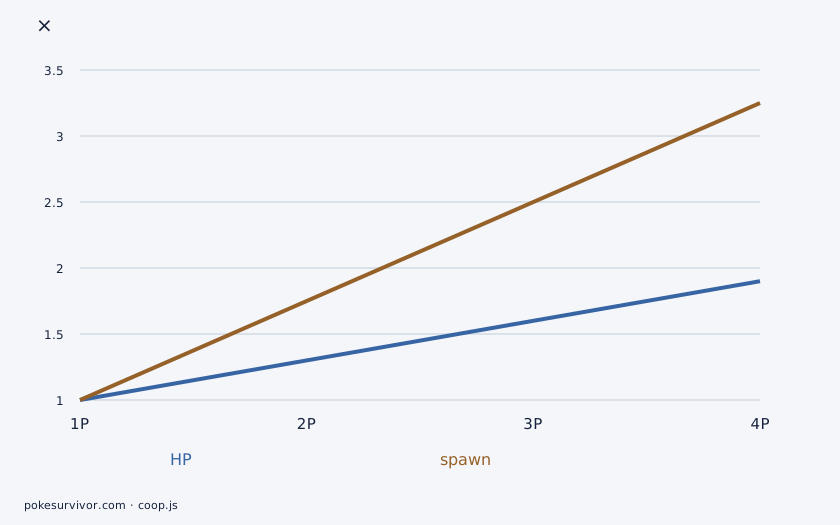
Adding a player also changes enemy scaling. Count the occupied player slots when planning a co-op group; for solo comparisons, use the one-player scaling values even if you are comparing several candidates. Spawn scaling and enemy HP are separate factors, so increased player count does not simply divide the same encounter among more attacks.
| Players | Enemy HP multiplier | Spawn multiplier |
|---|---|---|
| 1 | ×1 | ×1 |
| 2 | ×1.3 | ×1.75 |
| 3 | ×1.6 | ×2.5 |
| 4 | ×1.9 | ×3.25 |
At four players the HP factor is ×1.9 and the spawn factor is ×3.25. Coordinate each player's active attack and coverage gaps; stronger type coverage alone cannot predict your completion time.